We’ll walk you through the five best gas pressure washers of 2026 for heavy‑duty cleaning, focusing on power, durability, and real‑world performance. We’ll compare PSI, GPM, engines, pumps, and usability so you can choose the right tool for big jobs—and point out the models that genuinely stand out.
Some of the links in this article may be affiliate links. If you make a purchase through these links, we may earn a small commission at no extra cost to you. Thank you.
PowerSmart 3400 PSI Gas Pressure Washer 212CC

- Old version of gas-powered 3400 PSI pressure washer
- Effortless Start System & 212cc 4-Stroke OHV Engine – This 3400 PSI gas pressure washer features a user-friendly pull-start mechanism that gets the 212cc OHV engine running in seconds. No complex setup—just pull and clean! The 4-stroke design eliminates oil-gas mixing, cutting maintenance time.er
- 3400 PSI & 2.5 GPM for Fast Cleaning – Deliver powerful 3400 PSI pressure and 2.5 GPM flow to blast away dirt, grime, and stains on driveways, patios, and vehicles. Save hours compared to lower-powered pressure washers.
- 5 Nozzles for Versatile Cleaning – Equipped with 5 quick-connect nozzles (0°, 15°, 25°, 40°, and soap nozzle), this gas power washer offers customizable cleaning solutions. From intense spot cleaning (0°) to gentle washing (40°), handle every task with precision.
- Portable Design for Any Space – Lightweight frame with wheels makes it easy to move around yards or job sites. Foldable handle saves storage space in garages or sheds.
Who needs a heavy-duty cleaner that’s still easy to move and maintain? We recommend the PowerSmart 3400 PSI Gas Pressure Washer 212CC for homeowners and pros who want power without fuss. It delivers 3400 PSI at 2.5 GPM from a 212cc 4‑stroke OHV engine, so no oil‑gas mixing and simple upkeep. The pull‑start gets us cleaning fast. Five quick‑connect nozzles (0°, 15°, 25°, 40°, soap) cover stubborn stains to delicate surfaces. Ten‑inch wheels and a foldable handle make transport and storage simple. We use it on driveways, patios, cars, fences—versatile, reliable, and compact. It handles tough grime while staying easy to operate.
Simpson 3500 PSI Honda GX200 Gas Pressure Washer

- SIMPSON PRESSURE WASHER FOR PROFESSIONALS: The Simpson PowerShot gas power washer cleans decks, driveways, siding, fencing, equipment, and graffiti; The cold water machine is great for contractors; 49-State Compliant (Not for sale in California)
- ENGINE & PUMP: Premium Honda GX200 engine starts easily and includes low-oil shutdown; 3300 PSI 2.5 GPM AAA triplex pump with an integrated unloader and thermal relief to prevent overheating; Designed for a long service life
- LONG HOSE REACH: The Simpson Morflex series 25' high-pressure hose resists kinks and abrasion; Non-marring polyurethane jacket helps protect finished surfaces; Pump/Hose Connection: Threaded M22 connection
- EASY MOBILITY: 10" premium pneumatic tires roll smoothly over gravel, grass, and curbs; Balanced layout improves transport; The welded steel frame with powder-coated finish is easy to assemble and resists corrosion; 21" L x 24" W x 34" H; 74 lb.
- PRO PRESSURE WASHER ACCESSORIES: Five quick-connect pressure washer tips (0°, 15°, 25°, 40°, and soap nozzle) cover tasks from stripping paint to car cleaning; Rear-load M22 pressure washer gun and 16" spray wand included

Built around a 3500 PSI Honda GX200 engine and a commercial-grade AAA AX300 pump, the Simpson 61014 is our pick for contractors who need reliable, high-pressure performance for deck cleaning, wood restoration, and paint prep. Its 2.5 GPM flow, PowerBoost nozzle enhancement, and direct-drive efficiency deliver consistent cleaning force. A thermal relief protects the axial cam pump during sustained work. The welded powder-coated frame and 10-inch pneumatic tires make it durable and mobile at 74 lbs. It ships with a MorFlex 25′ hose, five quick-connect nozzles, ergonomic gun, and 16″ steel wand. Easy to assemble, 49-state compliant, maintenance-free for demanding jobs and reliable.
BILT HARD 3500 PSI Gas Pressure Washer

If you need contractor-grade cleaning power for driveways, decks, and paint prep, we recommend the BILT HARD 3500 PSI since its 7.5HP 224cc engine and maintenance-free axial cam pump deliver up to 3500 PSI and 2.5 GPM for consistent, heavy-duty performance. We find the 7.5HP OHV motor produces 9.96 ft-lbs torque for tough stains, while the powder-coated steel frame and 3/5″×25′ steel-braided hose resist corrosion and abrasion. Five quick-connect nozzles span 0°–40° plus soap for versatile surfaces. Ten-inch never-flat wheels, soft handle, 0.9-gal fuel tank, 1-gal soap reservoir, and SAE 10W-30 oil compatibility make it job-site ready and durable.
4200 PSI 2.8 GPM Gas Pressure Washer 212cc
No products found.
For homeowners and detailers who need gentle, controlled cleaning, we recommend a 212cc gas pressure washer that delivers a low-pressure/soap setting and a moderate 2.8 GPM flow so you can apply detergent without damaging surfaces. Still, when you need brute force it steps up: the same 212cc engine produces up to 4200 PSI for stubborn grime, while five quick-connect nozzles let us switch patterns fast. A 25-foot hose and onboard soap tank simplify work, and large never-flat wheels plus a rust-resistant frame keep it durable and mobile. It’s ETL and CARB/EPA compliant. We trust it for demanding cleanup jobs.
4200 PSI Gas Pressure Washer 212CC 4.0 GPM
No products found.
With 4200 PSI at 4.0 GPM, this 212cc gas pressure washer is ideal when you need contractor-grade cleaning power for driveways, decks, siding, and heavy paint prep. We use it for deep cleaning with a 7HP 4‑stroke 212cc engine and axial‑cam pump. It includes five quick‑connect nozzles (0°,15°,25°,40°,60°) and soap, a 3L adjustable soap tank with auto‑mix, a 32ft steel‑braided hose and 1/4″ quick‑connect wand. Rugged steel frame, never‑flat wheels, 3.6L fuel tank and tool hooks; jobsite‑ready. CARB/EPA/ETL compliant, two‑year warranty. Maintain ~0.2 gal oil, keep fuel below the filler neck; slight residual test fuel is normal and portable.
Factors to Consider When Choosing Gas Pressure Washers
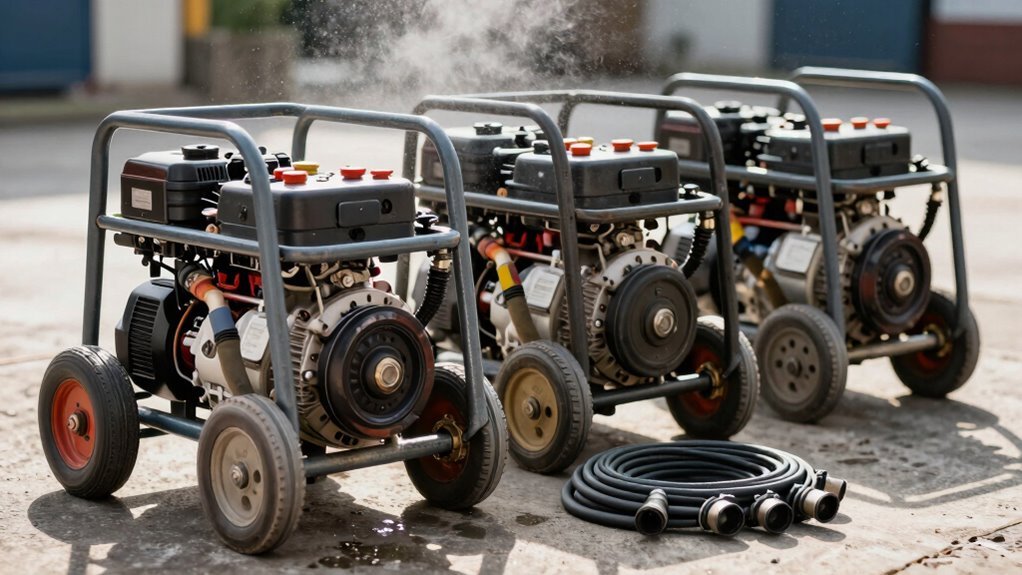
We’ll look at pressure and flow, engine type and power, pump quality and type, nozzles and accessories, and portability and weight. Each factor directly affects cleaning performance, durability, and ease of use. Let’s compare how they match your cleaning tasks and budget.
Pressure and Flow
How do pressure and flow work together to define a gas pressure washer’s cleaning power? We look at two metrics: PSI measures force, so higher PSI helps strip tough stains and clean hard surfaces. GPM measures water volume, so higher GPM speeds rinsing and covers large areas efficiently. Together they determine cleaning effectiveness; high PSI with low GPM can concentrate force and risk surface damage, while high GPM with low PSI may wet and rinse without removing stubborn grime. For heavy-duty jobs we recommend balanced specs—both sufficient PSI to dislodge dirt and adequate GPM to flush it away. Choose PSI and GPM based on the surface and task to guarantee effective, safe, and time‑efficient cleaning. We’ll match specs to your project for ideal results.
Engine Type and Power
To get the pressures and flows you need, we also have to take into account the engine that drives the pump. We prefer 4-stroke engines for reliability and easier maintenance, though 2-strokes appear in lighter, portable models. Horsepower and displacement (CC) directly influence the unit’s pressure and flow capabilities, so higher-specific power engines—like 212cc or 224cc—typically deliver the muscle for heavy-duty cleaning. Start systems matter: recoil is simple and lighter, while electric start gives quicker, less strenuous startups. We also weigh durability and fuel efficiency, since longer jobs demand engines that run reliably and economically. Balancing HP/CC, start convenience, and proven durability helps us choose a washer that meets tough cleaning needs. We prioritize engines matching task intensity to maximize performance and uptime consistently.
Pump Quality and Type
Because the pump is the heart of any gas pressure washer, we judge models first on build quality, type, and serviceability. Brass and aluminum components resist corrosion and last longer under heavy use, so we favor pumps with metal manifolds and fittings. Consumer units often use axial‑cam pumps for simplicity and low maintenance, while pros use triplex pumps for superior longevity and steady performance. We check maximum pressure ratings alongside consistent GPM, since both determine cleaning power. Thermal relief protects against overheating during prolonged runs and profoundly extends pump life. Finally, easy access to seals, valves, and service points makes routine maintenance and repairs straightforward, keeping performance ideal and reducing downtime on demanding jobs. We also prioritize parts availability and warranty coverage often matters.
Nozzles and Accessories
After checking pump quality, we next look at nozzles and accessories that determine spray pattern, chemical delivery, and overall versatility. We prefer machines with multiple quick‑connect nozzles (0°, 15°, 25°, 40° and soap) so we can tailor spray intensity to surfaces. Adjustable nozzles and detergent spray kits let us modulate pressure and chemical mix for stubborn grime. We value stainless steel or brass nozzle components for resistance to high‑pressure wear. Useful accessories — extension wands, surface cleaners and foam cannon attachments — expand reach and task options. A built‑in soap tank or reliable compatibility with external detergents streamlines chemical application. Prioritize models with durable fittings and a full accessory list to maximize cleaning flexibility and longevity. Also check nozzle sizes and spare parts availability before purchase too.
Portability and Weight
While lighter gas pressure washers—typically under 50 lbs—are easier to move and suit frequent transport or tight spaces, heavier units over 70 lbs usually need handles or wheels but deliver greater stability during operation. We recommend matching weight to how and where you’ll work: choose lightweight, compact models with foldable or detachable handles if you’re hauling the unit often or storing it in limited space. For jobs on uneven ground, prioritize models with large pneumatic or never‑flat wheels to improve maneuverability and reduce strain. Always consider your physical strength and task requirements; an underpowered person carrying a heavy machine raises safety risks and slows work. Balancing portability with stability keeps projects efficient and safer. We’ll weigh these factors when recommending models for specific needs.
Maintenance and Warranty
How often should we maintain a gas pressure washer? We should check engine oil—use SAE 10W-30—and change it regularly, inspect hoses and nozzles for wear, and clean parts after use. Proper storage and routine cleaning extend lifespan and help avoid repairs that could arise during the warranty period. Most units carry one- to three-year warranties covering parts and manufacturing defects, but warranties often require proof of maintenance and following manufacturer guidelines to remain valid. Some models include maintenance-free pumps or sealed components that lower service needs, yet periodic inspections are still wise. Before buying, we recommend confirming warranty length, covered items, required maintenance records, and availability of authorized service to protect our investment. Check registration steps and transferable coverage if you plan resale later.